Bruno Schulz as a Literary Hero – Inspirations and Interpretations
Literary and Academic Writings of the IV International Bruno Schulz Festival in Drohobych Ukraine 2010
Essay by Jan Hontscharenko – Title: About Bruno Schulz – What triggered his mind? Notes on the blind sources of the unconsciousness
Text is written and published in English language translated into Polish and Ukrainian language. Publisher: Ivan Franko State University, Drohobych, Ukraine. Editor and director of Bruno Schulz Festival and moderator Wiera Meniok.
My first meeting with Mister Bruno Schulz was the reading of his novel ‘Cinnamon Shops‘ in Dutch translation, in the year 1972. It is shocking but true, before 1972 Bruno Schulz did not exist in Holland. But in 1972 Schulz was born in Holland, thanks to the effort of the translator, the great wonderfully gifted man, Gerard Rasch. He translated not only Schulz, but also Konwicki, Witkiewicz, Gombrowicz, Milosz, Zagajewski, Herbert and Szymborska and many more poets from Poland. His enormous input of Polish literature in Holland is invaluable.
Of all the authors he translated, he told me once, Bruno Schulz was the mot close to his heart. He translated ‘The Cinnamon Shops’ and ‘Sanatorium Clepsydra’ two times in different versions. He was a real fanatic, truly positively obsessed to introduce the same quality of prose, from the original Polish language into the Dutch equivalent. He was a poet himself in a very modest way, placing himself in the spaceless shadows of the Polish poets he admired. He would have loved to be here in this Schulz Festival 2010. Like many authors he has translated, Gerard Rasch himself is no longer admits the living. He died in 2004, but his two lovely Dutch daughters are picking up the translation work of their father, and they have as much talent as their father.
I was in 1972 the beginning literary critic of the local newspaper, covering Russian and East-European literature, and received a free copy of ‘The Cinnamon Shops’ from Schulz’s Dutch publisher Meulenhoff in Amsterdam. The same publisher who republished the complete works of Schulz in 2006 in an exclusive design.
For me Bruno Schulz was an unknown Polish author. And to tell honestly: I was not waiting for yet another sparkling genius to appear in world-literature. The great Russian literature was absorbing me, with many appealing poems, short stories and novels, like ‘War and Peace’, ‘Eugene Onegin’, ‘The nose’, and ‘Notes from the Underground’.
As I young reader my agenda was already booked for decades. I realized: millions of pages I had to read in the future. There was no end to all the beautiful literature awaiting for me. So I started to read Bruno Schulz as a kind of intermezzo, in between the Russians classics, and I must say, with no regrets whatsoever, on the contrary, his ‘Cinnamon Shops’ is a breathtaking novel, a brilliant masterpiece. I was crashed after reading it, it echoed in my mind for a long time. I was taken completely by surprise and was immediately captured in the somehow surrealistic somehow naive and mystical dreamworld of Schulz. His incredible imaginary richness evoked the music of language.
What I found especially striking was the metrical-graphic compactness of his texts, his flow of excessive details, his fine arrangements of overloaded but lyrically balanced sentences. His choice of words seems like drugs-related: one hallucinatory experience after the after, tumbling over each other, the pounding energy of it, chasing mysticism of life.
Also striking is the eloquent way he was going down to his childhood, a childhood truly in his case a writer’s goldmine. What do little boys see and feel when they are growing up? A lot adolescents just don’t see. Schulz managed to depict the soulful world of boyhood. This is one of his most touching qualities. Having been a boy myself I could closely relate to the sensitive narrator in ‘The Cinnamon Shops’ who was so open-eyed for the natural beauty of life.

uitsnede van zelfportret bruno schulz 1935
Schulz is so intense, you can not read him as you read for example a newspaper, you need far more concentration, and you will have to adjust to the slowness of taking it all in, all the information he compressed in his typical unrestrained overwhelming style. In this regard Schulz is indeed comparable with Marcel Proust, an author I did not really hate but disliked, because of all his fancy adjectives, missing a certain necessity, adjectives which are more colourful decorations and ornaments of the cathedrals Proust as a prose-architect designed.
With all my respect towards his virtuosity, and giving him the benefit of the doubt in regard of his artificiality, Proust did not warm my feelings. Bruno Schulz did. He spell bounded me. He had a kind of Alice in Wonderland-effect on me. I was hooked from day one when I read ‘Cinnamon Shops’ and after that I read all of his work for so far it was available in Dutch translations.
Later I decided to go into novel writing myself. (Maybe Mister Bruno Schulz is my source of all the pain and pleasures, agony and ecstasy, that I have experienced writing about my personal life.) Of course I had to forget and leave Schulz’s style and describe my experiences with a more distant approach, with the right doses of irony, which is by the way a major characteristic of Dutch literature, passionate and stylistic ornamental effects are not at all appreciated in Dutch literature, because in Amsterdam we are very distant, we are recollected persons, direct, to the point, very cool, describing metaphysical sentiments is in modern Dutch literature not done, it is synonymous to pathetic feelings. Metaphysic’s do not matter in our literature, they have a bad smell, and full moon romanticism was and is today strictly taboo also.
So I had a problem writing my own prose, although I mastered the Dutch language well enough to bring it to a literary, personal lyrical level, I nevertheless still hesitated: what to do? Finally I worked out a kind of symbioses: write distantly in Dutch tradition, but try to mix it with the warm lyrical pallet of east European, Ukrainian glow. After all, in blood, heart and spirit, I am half Ukrainian and half Dutch, so I somehow had to make a compromise.
After years and years, after one crazy experiment after the other, I was still not satisfied with the fiction I had produced, but I was determined to write along and I kept searching for the right form and atmosphere of my prose. Finally I had managed to do so, controlling the discipline of staying at distance, and one day, a big day in my life, a real unsurpassed highlight, there it was: my first novel entitled ‘Platform lovers’, which is a kind of postmodern story about my journey, from Amsterdam to Moscow and Kiev by train, just after the perestroika and glasnost had exploded. I was having a short love affair with a Russian artist in Moscow, and after I unexpectedly had to break up with her, a frustrated, vodka addicted, paranoid and jealous personage, I travelled down to Kiev, and from this beautiful city I travelled to my last station in the with sunflowers decorated countryside of Ukraine: the small and remote village Celo Lowin, close to Chernobyl, where I encounter for the first time my Ukraine family, impersonated by my only ant Nadia, the sister of my mother. In this adventurous quest to the roots, with flashbacks to the events of my past, I integrated many references towards and reflections on Russian literature.
My debut novel was commercially not a big success. Only the happy few in Holland, so to speak, could relate to all my references, which I used as a framework. The plain fact was: I failed to address this book to a big audience, although I created respect from some critics and readers. Reflections on my debut were positive. I received many praising reviews. But my publisher was from a commercial point of view disappointed. I unfortunately could no go into deep discussion with him, because soon after my publications he died, due to aids. And soon after him my beloved editor died at young age, she went to sleep and never woke up.
Any tragedy of course carves deep sadness in the soul, in my case, facing two sudden funerals of my friends, this resulted into paralysing depressions, which made active novel-writing impossible. I severely suffered what we call a writer’s block. Staring at the with page all the time, an empty screen, waiting for words to come. But they were gone, as if they were hiding behind a black curtain which I could not open. Just like a painter, every writer needs a bit of light, to see what he’s doing, and painters they have a finest hour, just before sunset, but there is only the night for the writer, when he struggles to get his ideas realized, in solitude.
Bruno Schulz was a victim of the bizarre insanity of the Second World War. With his tragic death in mind, all my own personal sufferings in my life seemed to be relatively so little, so small, so thin, almost next to nothing.
If we reflect on Schulz’s fate, one thing is clear: cruelty and absurdity do not have any boundaries. It is a shame he did not found an emergency exit to escape from the guns of the Gestapo. If we in our imagination take a historical flashforward, what would he had written if he had survived? We can only guess.
Right after Platform lovers I published my second book, the autobiographical novella entitled: Hand kiss. (Let me put the major themes in a nutshell: losing a suicidal dog, called Pushkin, ending up a long term relationship, fading love, moving out from the village into a big city, looking out for a new love in Amsterdam and how to express admiration for an old almost stiff deaf professor of Russian literature.)
Because one of the sub-motifs, idolatry, I made a direct reference to Bruno Schulz’s prints which are assembled in the famous ‘The Book of Idolatry’. In my novella I described how passionately men, reduced into dwarfs, are kissing the feet of a aureole woman, paying their respect and compliments crawling on their knees. I focused on Schulz’s fetish for the female feet, in which I read a great lesson of humbleness. Schulz depicted a graceful way of worshipping, without compromise or apology. I like the dark weirdness of the theatrical scenes in his pictures of idolatry, very original. But of course we can not overlook the analysis of masochistic elements in those pictures.
In my story I made a link to this masochism: if I would have kissed the hand of the professor, during his party for intellectuals only, celebrating his new book about the history of Russian literature, and of course the professor would have been deeply embarrassed, would I in that situation as a true worshipper derive pleasure from the fact that I made a fool of myself?
This inner struggle, which I exaggerated slightly, is more or less the tension in my novella.
What triggered the mind of Bruno Schulz? I am sure there are many theories produced by Schulz-experts. But I think his amazing idiosyncratic and imaginative works are based upon the sheer willingness and open-mindedness to let the unconsciousness speak. I think Schulz’s oeuvre is a wonderful example of how successful this procedure can turn out.
Maybe the schedules of his storytelling were not precisely so mathematically well thought-out as they seem to be, maybe he worked more with pure intuitive improvisations. Almost every writer I know is a control-freak who wants not only to control the technique of grammar but also to have a firm grip on the style of how to express ideas, memories and the landscapes of emotions.
Many writers will start working on a new novel only when they have a rough/sketchy overview of the complete content. They work like robots, following their own fictional master plan. Rationality comes first. Clearly they see what is going to happen during the process of novel-writing. They control the middle section between the beginning and the end, with or without plot. And they are programmed not to accept any defiance. Major improvisations will be rejected, regarded as irrelevant to the story.
On the other hand I know writers who work with their intuition first of all. They just go along with the flow. During this free minded and unframed writing process, which they experience as a kind of pleasant addiction, close to rapture, they are looking with their third eye, in their inner space, at something yet unknown to them. They rely on the blind sources of the unconsciousness.
To explain the conception of blind sources there’s the metaphor of the rolled up Persian carpet, which is slowly, chapter by chapter unfolding itself. At the end, when the book is finished, when the carpet is completely unfolded, then it reveal its pattern, and surprisingly all seems to be okay, all bits and pieces fell into place. Once he sees the pattern, the writer knows that he has completed his work successfully. His adventure, not knowing what the pattern exactly was, the frames of thought he was following, provides at the end a great feeling of bliss.
This experimental method is generated by what we could call, with the help of a paradox: Unconscious Knowledge. Having read Schulz over and over again, I think his Unconscious Knowledge is without doubt omnipresent in his oeuvre. I will outline this with one rather funny example. In the short chapter ‘Nimrod’ of ‘Cinnamon Shops’ he describes the sudden arrival of a young dog, appearing out of nowhere. With feelings of sympathy for and amazement by this tailed creature on four feet, he emphasizes sort of the genetic package which the young dog carries in his being. Nimrod, the name of the dog, knows how to behave as a dog, what to do and what not to do. A matter of instincts? Genes and heredity, what we call the blueprint of DNA – the genetic instructions used in the development and functioning of all known living organisms? Yes of course.
But what Bruno Schulz was trying to focus on, apart from his flirtation with the idea of Darwinian determinism, is the hint towards the fact of origin versus predestination of existence, that counts for as well all the animals on the planet, as well for the human condition. In his bones and flesh the doggy Nimrod is gifted with Unconscious Knowledge.
This knowledge is yet like a riddle, an oracle maybe as introduced in Greek mythology, but sooner or later Nimrod will work out a concrete type of balance and harmony in his behaviour, he will find inner peace within himself, the synthesis of his strengths and limitations. The storyteller Schulz as a young boy, is fascinated by this wonder of creation, he can identify himself with the young dog.
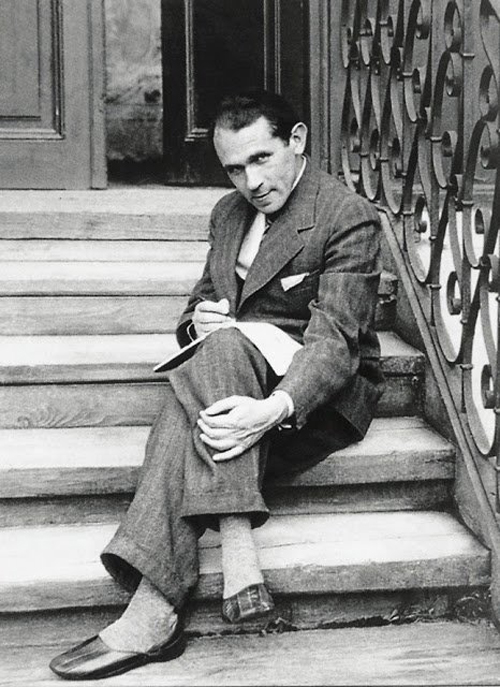
Bruno Schulz 1935 Drohobych
I like to point out that the conception of relying on the blind sources of the unconsciousness, being aware of having and working with Unconscious Knowledge, can not be associated and by no means to be compared, historically and conceptually, with the so called Dada and Surrealist movement: l’ ecrivant automatique, the automatic writing, which was popular in Paris by the work of the surrealist writer and painter Andre Breton (he lived from 1896 to 1966, belongs to the same generation as Schulz).
This movement, automatic writing, was a kind of pamphlet and manifesto to celebrate anti-literature, it was provocative towards the bourgeois establishment. The results of these experiments were, from point of view of the reader, one big disappointment. But that was the very purpose, I believe, of the surrealists and Dada writers. They made however a clear point: reality is not always what it apparently seems to be and what it would like to be as a construction of rational components. Reality, also in Schulz’s optics, is a sheer impenetrable mystery, which can only be explored by art, the power of creative energy, sometimes enlightened by the credo that all what happens is good because it happens. There are many I repeat many major differences, but what Schulz has in common with Breton is the fact that both believed in a transcendence beyond human understanding.
What about the universal appeal of Schulz oeuvre? His work has been translated in about 39 languages all over the world, which is by the way not a bad score for a non bestseller-writer. It is well-known, a writer can not be universal when he writes about only the chickens on his yard in his little village, in a forgotten place somewhere, wherever in the world. But Schulz, he is an exception, a truly universal writer, now he has a global audience, but actually he was a small villagers writer, to his advance rooted in the great epic tradition of Hebrew literature, in which many orally transformed story’s, unique, fantastic and absurd fairy-tails are incorporated. His awareness of Hebrew biblical stories, with all the mythological connotations, lifted up his own stories. What he did was adding his own fantasy’s to this great literature. And it turned out, posthumously: he was very successful in that format.
I think the success of his his oeuvre, however small but glorious, is because of his implicit tribute to the power of the unconsciousness. It takes courage to rely on the blind sources. It is tricky, you cannot be afraid to take risks. The fear of ending out into nowhere-land, in oblivion, being left into the dark, plays an important part. Fear as a psychological condition, is not a drive to write literature. Fear is maybe a motif to murder someone. But with fear you cannot write fiction. Fear has no wings. Fear is destructive. With fear you will end up nowhere.
On the contrary of fear, strong personal confidence is necessarily, the personal conviction that whatever you write will be okay somehow, and important somehow, not only to built up your own ego but also, in engagement with the outside world, to enrich the cultural values of the society you live in.
Relying on the blind sources can be very forceful, it depends, it can also be a truly liberating way of working in novel-writing. I happily have experienced the liberating aspects myself, for example: a passage that by coincidence popped up, not at all foreseen, nice images coming out of the blue, or a an appropriate metaphor that appears, without the act of thinking, or a surprising unexpected neologism, all of this kind of coincidental material is a natural, organic part of the magic of writing.
According to general psychological theory the unconsciousness is a brain connected domain in the structure of our personality, with containers full of lurking experiences, images, impressions, nondescript or super-clear, blur observations, a volcano of hidden feelings, seeds of evil and the good, involuntary memories, all kinds of stuff synthetically together associated in an abstract and complex world. A world which is, as far we know, constructed like a labyrinth. How the unconscious exactly works, for example what kind of role it performs in our desire for knowledge and reconciliation with fate, by the encounter of emotional stimuli or impulsive input of our imagination, or more in our dreams, nobody really knows.
The unconscious has its own misty sources, sources we can not see clearly. Its hard to say: I will only use one particular source of the unconscious, because the unconscious cannot be controlled by the conscious, there’s always nighttime in the unconscious regions of the mind, we have no tools, no keys to lock or unlock it, no lights to make it appear as a recognizable, substantial and functional part of our personality.
Sigmund Freud, the founder of the psychoanalysis said, I quote: ‘Each mental process starts unconsciously and it can stay and develop itself into the consciousness.’ This Freudian concept is interesting. Suppose it is true, then the unconsciousness must be very smart. It is like an uninvited quest who can not be sent away. Bruno Schulz understood the conflicting, contra-dictionary relationship of the conscious and the unconscious very well. He integrated this insight in his fiction, both paintings and writings. This way he could work out his program of mystifying the reality.
The blind sources are very favourable for escapists, who refuse to take responsibly for their actual deeds, who are in a nihilistic way indifferent towards their own existence and ignore the facts of life. Daydreamers, losers, sometimes helplessly mentally ill, traumatized, close to insanity. In what way did Bruno Schulz rely on the blind sources? By the way he portraits his father in ‘Cinnamon shops’ he was aware of the insane. Many times, since I know him, I think he maybe was a not self-chosen escapist, someone who, entangled with the burden of disillusionment, could not cope with the banality of the real everyday world, and therefore used literature and visual art as his drugs?
I don’t like sharp judgments, they can be preconceived. But also I do not like to idealize any author, whosoever, as a hero who blessedly received a kind of spark of the divine, like St. August of Assisi, friend of the fishes. Of course, undoubtedly, Schulz was sincerely inspired, but inspiration can not be mistaken, underestimated nor overestimated. My question is: can inspiration be called upon by exercising novelwriting every day, year in, year out? And, if not, is there a specific trick traceable, only known by wizards amongst the novelists, such as Nikolai Gogol, Franz Kafka, James Joyce and Samuel Beckett?
This technical question about inspiration and the routine of literary tricks and effects brings us to the following essential question: what is the most direct connection of memory and the historical continuum of the past towards the actual modern reality? In other words: what is the relationship of myth and reality in the works of Bruno Schulz that hypnotized his global audience up-till now, the year 2010?
Did he, after his beloved father died, wanted to bring back the past he was desperately missing? Did he at whatever costs wanted to lean on to the world of the past recaptured, described by Marcel Proust as ‘Les temps perdu’ , the lost time, in his classic novel ‘À la recherche du temps perdu’? I don’t know if Schulz has read Proust, if he did, than he must have noticed how favourably Proust worked with the idea of involuntary memory, the technique of evoking recollections of the past without much conscious effort. The remembrance of things past comes into action more by involuntary than voluntary memory. Proust made a clear point about this and I think Schulz would not have disagreed. He used this literary Proustian method to full extend.
How many differently interpretable layers do we have to look trough, with or without a magnifying glass or the filters of linguists, before we will find out what he really wanted to tell us? Was his motivation to write fiction self-referential, was he trying to found out the inconvenient truth about the human condition and parallel to this: was he in his own existential bewitchment driven to found out why he himself was born in the not so easy circumstances he had to deal with, trapped in the time-line of dramatic chances?
Schulz was extremely concentrated on language, in his view a superior medium. Of course, every writer understands what he wants to find out, explore, what the structures of language can do, how they work as powerful symbolic vehicles of descriptive systems. But could it be that Schulz was looking for more, was he searching for the manifestation of the unknown, secret reality?
Personally I am not deeply interested in that metaphysical question, which leads to the question how much Schulz was influence by mysticism. I am more interested in how Schulz emphasized the ambiguity of language. His use and misuse of textual procedures and techniques employs simultaneously prose and poetry, applied and interwoven layer by layer, without disturbing their own autonomy and characteristics. That’s one of the reasons Schulz has the reputation of a writer’s writer. He freely mixed both disciplines. Therefore we can roughly categorize him as an experimental writer, who respected the tradition of the grotesque and absurdism.
Bruno Schulz was working on an all-embracing literary project in his birthplace Drohobych. In his lifetime, before the German Nazi’s invaded Ukraine, Drohobych was probably synonymous to silence and meditation, a place with the heartbeat of dreams and promising peace. A real oases for a writer like Schulz who did not care about travelling around the world. At home in Drohobych he developed his own personal imaginative voyages.
Did Schulz live in a dreamworld in which he hoped the messiah vision of the paradise would manifest itself, the paradise we have lost?
I myself am still pondering on this maybe totally useless nevertheless charming question. However, the vague memory of paradise, lost forever, will never leave the human universe. It’s one of the archetypes of our collective memory, that forms the background of our in fact unreal and irrational desire to experience uncomplicated happiness.
I have expressed many questions in this essay, challenged by the program of this Great Schulz Festival 2010. This festival opens an unique international dialogue between novelists, translators, scientists and artists, and will offer new perspectives in the spectrum of interpretations, the genesis of Schulz’s work, which is fundamentally based upon all possible critical questions, about Schulz especially, but also about literature as an artform in general.
Questions – the essence of philosophy – they are for the sake of deep understanding more important than answers. To formulate one-dimensional black and white answers, that belongs to cheap dogmatic rhetorical circles. We can only refine and nuance questions and consequently hope that in the complexity and elaborateness of all what matters concerning Maestro Bruno Schulz’s work, the beauty and significance of his oeuvre will become even more beautiful and significant.
Jan Hontscharenko, Amsterdam.